Packaging & Production
Every beverage brand hits the same crossroads: glass, PET, or aluminium? The choice touches your energy costs, your logistics, your sustainability story, and how smoothly your liquid filling machinery runs at scale. Here’s how each format holds up across the metrics that actually matter.
Energy efficiency
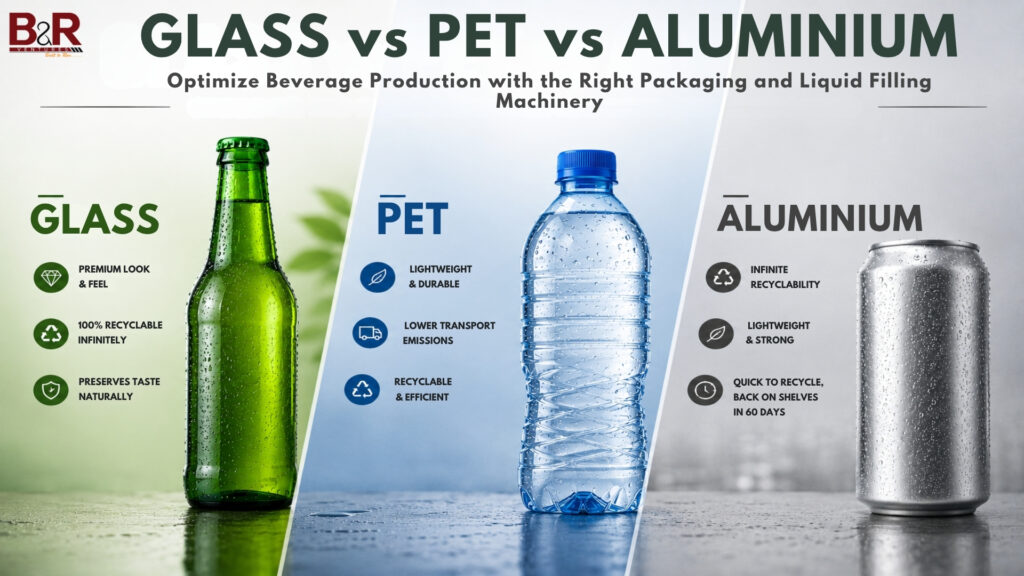
Glass: Glass is the most energy-intensive of the three. Melting raw materials requires furnace temperatures above 1,500°C, a significant energy load before a single bottle reaches your filling line.
PET: PET requires considerably less energy to manufacture from virgin resin. Using recycled PET (R-PET) cuts that further by around 70%, making it increasingly attractive as recycled content availability grows.
Aluminium: Primary aluminium smelting is energy-heavy, but recycled aluminium uses roughly 95% less energy than virgin production. Your recycling rate is the swing factor; the higher it is, the better aluminium’s energy story becomes.
Lightweight advantage
Glass: A standard 500ml glass bottle weighs 300–350g. That weight adds up fast across pallets and transport runs, increasing fuel costs and handling strain at every stage of distribution.
PET: The same 500ml in PET weighs around 20–25g, a fraction of glass. This dramatically lowers transport costs and makes PET the clear winner on logistics weight.
Aluminium: A 330ml aluminium can weighs roughly 13–15g. Its structural rigidity also means excellent stack ability and low breakage risk, making it highly compatible with high speed beverage filling machinery.
Performance and logistics efficiency
Glass: Glass travels as finished containers. There’s no logistics shortcut; every bottle occupies full volume in transit, requiring more trucks, more warehouse space, and more coordination with suppliers.
PET: PET’s biggest logistics advantage is the preform. Rather than shipping finished bottles, producers ship compact plastic blanks blown into containers on site. One truck of preforms replaces roughly twenty trucks of finished bottles, a supply chain advantage no other format can match.
Aluminium: Like glass, aluminium travels as finished cans. However, cans stack efficiently, and their uniform dimensions integrate well with automated production lines and liquid filling machinery setups.
Recyclability and circularity
Glass: Glass is infinitely recyclable without loss of quality. In practice, real-world collection rates vary significantly by region. Without deposit return schemes, much of it ends up in lower-value applications rather than in new bottles.
PET: Food-grade rPET technology is mature, but contamination and supply constraints limit how much recycled content actually makes it back into beverage bottles. Legislation mandating minimum recycled content is pushing the sector forward.
Aluminium: Aluminium has the strongest real-world recycling record. In many markets, over 70% of cans are recycled, and the material can be back on shelves within 60 days. The closed-loop story here is genuinely compelling.
Our final thoughts
No single format wins on every front. Glass suits premium brands where perceived quality and taste preservation matter most. PET is the operational workhorse, unbeatable on weight, performance, logistics, and line flexibility. Aluminium offers the strongest real-world re-cyclability and pairs well with high-speed beverage filling machinery.
The smartest producers don’t lock into one format. They run multiple lines to serve different channels, markets, and price points. Whatever format you choose, your filling equipment is what determines whether your packaging strategy actually delivers at production scale.